Dr. Susan's Smoothies for Life by Richards M.D. Susan
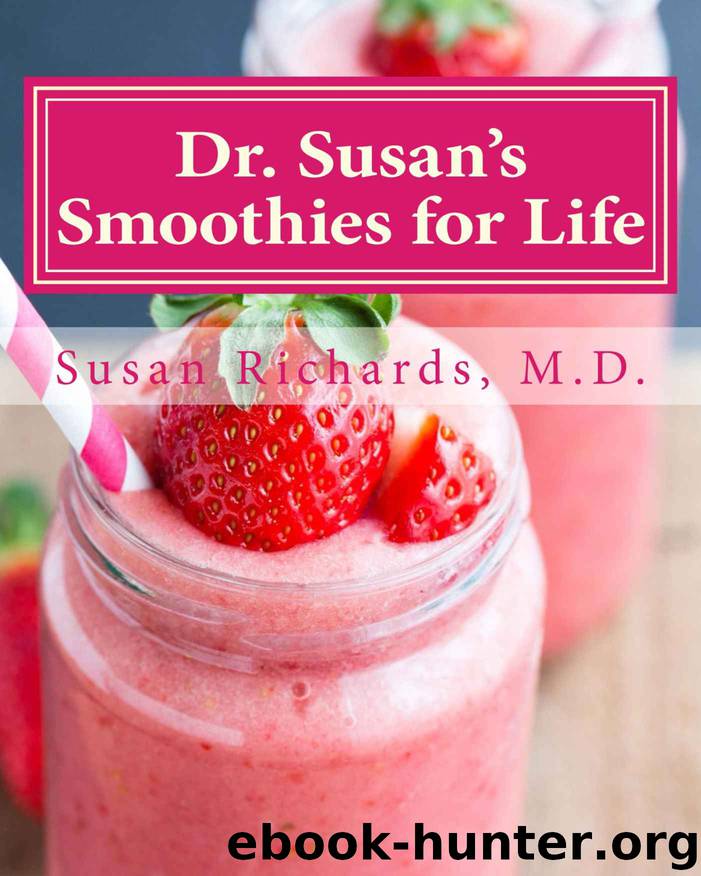
Author:Richards M.D., Susan
Language: eng
Format: epub
Published: 2015-05-21T04:00:00+00:00
natural sweeteners
Fruits are the main ingredient in most smoothies. They derive a good portion of their flavor from their natural sweetness. But if you want to add a little extra sweetener to your drinks, there are a number of great natural options available. There are many natural sweeteners that do not cause the health issues linked to the use of sugar and they are derived from vegetarian sources and even provide some health benefits.
Unfortunately, sweeteners (particularly processed table sugar) are greatly overused in our society. When used in excess, table sugar is a risk factor for diabetes, blood sugar imbalances and heart disease. It promotes obesity, the overgrowth of candida; adversely affects mood, energy levels and increases your risk of tooth decay.
I do want to emphasize that many of these sweeteners can be used interchangeably for the smoothie recipes in this book, so even if you have a preferred sweetener, you can substitute it for the sweeteners that I use in these recipes. However, not all sweeteners can be readily substituted. One such example would be molasses because of its thickness and viscosity.
In this exaction, I want to share helpful information about the best and most healthy natural sweeteners with you. These include stevia, xylose, agave nectar, coconut palm sugar, honey, maple syrup, fruit juice and molasses. Let’s look now at these natural sweeteners that you may want to add to your smoothies.
Stevia is an herbal-based sweetener that is calorie free. Thus, it is helpful if you are on a weight loss program or don’t want the extra calories found in other sweeteners such as sugar or honey. Because stevia contains no calories from sugar, it does not create imbalances in the blood sugar level. This is very beneficial if you suffer from hypoglycemia or diabetes.
Xylose, also known as xylitol, is a wonderful sweetener that is extracted from woody fibrous plants such as birch and other hardwoods. Xylose can also be found in guavas, pears, blackberries, aloe vera, loganberries, raspberries, psyllium seeds, broccoli, spinach, eggplant, peas, green beans, okra, cabbage, and corn. Xylitol is as sweet as sugar but has only two thirds the calories.
It gives a delicious flavor to baked goods, desserts and beverages without the health problems related to table sugar like diabetes, candida infections, obesity and tooth decay. Xylitol is absorbed more slowly than sugar so is helpful for diabetes, has antibacterial and antifungal properties and helps promote healthy teeth and gums.
I recommend xylitol as a sweetener because of its health benefits, unlike table sugar which is a very unhealthy food. Besides its antibacterial and antifungal properties, research studies suggest that xylose can help prevent digestive disorders and even cancer of the digestive tract. Xylose appears to discourage pathogens from binding to mucous membranes, and helps promote healthy teeth and gums.
Agave nectar is produced commercially from the blue agave plant. The core of the plant contains the “honey water” that is used as the base for the production of the nectar. Once the natural liquid is processed, it yields a product that has a consistency much like maple syrup and has a pleasing amber color.
Download
This site does not store any files on its server. We only index and link to content provided by other sites. Please contact the content providers to delete copyright contents if any and email us, we'll remove relevant links or contents immediately.
Whiskies (Collins Gem) by dominic roskrow(45525)
101 Whiskies to Try Before You Die by Ian Buxton(45314)
World's Best Whiskies by Dominic Roskrow(45119)
Whiskies Galore by Ian Buxton(42154)
The Fast Metabolism Diet Cookbook by Haylie Pomroy(21255)
Chic & Unique Celebration Cakes by Zoe Clark(20148)
Craft Beer for the Homebrewer by Michael Agnew(18342)
The Bone Broth Miracle: How an Ancient Remedy Can Improve Health, Fight Aging, and Boost Beauty by Ariane Resnick(16703)
For the Love of Europe by Rick Steves(14901)
Tools of Titans by Timothy Ferriss(8591)
Chowders and Soups by Liz Feltham(8432)
A Court of Wings and Ruin by Sarah J. Maas(8107)
How to Be a Bawse: A Guide to Conquering Life by Lilly Singh(7613)
The Institute by Stephen King(7151)
Cravings: Recipes for All the Food You Want to Eat by Chrissy Teigen & Adeena Sussman(6859)
Wiseguy by Nicholas Pileggi(5925)
The Last Wish (The Witcher Book 1) by Andrzej Sapkowski(5590)
Spare by Prince Harry The Duke of Sussex(5363)
Room 212 by Kate Stewart(5268)
